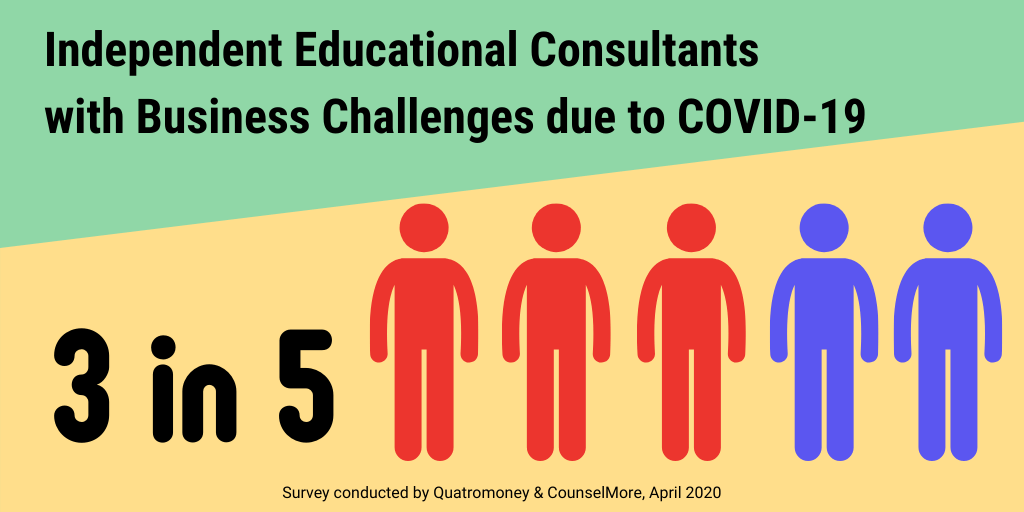
A recent Goldman Sachs survey of small businesses found that 96% have been affected by COVID-19. This got Quatromoney , and our friends at CounselMore , thinking about the impact on the independent educational consultant (IEC) community. Rather than guess at what might be happening, we decided to create a national flash survey to gauge how the pandemic is affecting the businesses of our IEC friends and partners. Over 200 IECs from across the nation responded to our survey (plus a smattering of IECs working in other countries). The results indicate that a majority of IECs, (60.3%) are struggling as a result of the pandemic and while less than the overall US small business community, the current economic conditions and changes in the higher education institutions are modifying the ways IECs do business.
Three out of Five IECs Are Experiencing the Negative Effect on Their Business
One of the key findings was that 60.3% of IEC respondents have already felt a negative impact to their businesses. This percentage was almost identical whether the IEC ran their own business (60.2%) or was in a business with others (60.5%). When we looked into the results of those who have yet to experience any negative effects of COVID-19 (39.8%), only 4.4% of the respondents remained confident that the pandemic would not affect their future business. A full 14.7% of the respondents who were not currently feeling the effects of the outbreak assume they will feel the effects in the future.
IECs who have been in the business for over 20 years (88.9%) are most likely to feel the business impact, followed by IECS with less than 2 years of experience (70.0%). Whereas those working as IECs between 3 to 19 years had similar results to the overall average findings (55.8%) on the negative effects.

When asked to describe why they were felt a negative impact to their businesses, IECs were given nine options to consider and asked to select all that apply and given the ability to provide their own reason:
- Client contact is limited due to social distancing.
- I have to do additional work (e.g., new applicants) for the same money.
- My number of clients is shrinking.
- I have had a reduction in paid hourly services.
- I am holding off paying bills.
- I am borrowing funds to help keep the business afloat.
- I am considering closing my rented or co-working office space.
- I am considering or have let go an employee.
- I am considering closing my practice.
The three top reasons for rethinking that were selected:
- 60.2% My number of clients is shrinking.
- 58.5% Client contact is limited due to social distancing.
- 25.2% I have to do additional work for the same money.
Write-in comments about the negative effects of COVID-19 centered around themes like “Reduction of inquiries for new clients,” “Uncertainty about 2020-2021 start date, gap years, deposits etc,” and “I've had to cancel my workshops, which generate about 60% of my income.”
In contrast, when respondents indicated that the coronavirus pandemic was not adversely affecting their businesses, they were given seven choices and asked to select all that apply and were also given the ability to provide their own reason:
- My business continues to thrive.
- I have added more clients during this crisis.
- I already used video conferencing to connect with clients.
- I am already using social media to connect with clients.
- I already worked out of a home office.
- My clients have even more flexibility to meet.
- I am confident in my contingency plan to meet my business needs.
The three top reasons for not rethinking that selected were:
- 77.8% I already used video conferencing to connect with clients.
- 71.6% I already worked out of a home office.
- 67.9% My clients have even more flexibility to meet.

For those writing their own comments on the neutral effects of coronavirus, the comments centered around themes such as “I'm relatively new to the business and depend upon referrals” and “I was already full and no one has dropped out.”
IECs Living in Urban Areas are Most Affected
IECs in urban communities (68.0%) are most likely to feel negative effects on their business in comparison to suburban (58.8%) or other responses (e.g., rural, undisclosed, mixed) (47.1%). As we dove further into the data, IECs in urban areas in other countries (75.0%) and the Northeast (71.4%) were most inclined to have negative effects on their business. This may be linked to proximity to the current clusters of confirmed COVID-19 cases. In contrast, IECs in urban areas in the Midwest are least likely to have adverse effects (33.3%).
Since 66.7% of the IEC survey respondents are located in suburban areas, it was interesting to see overall only 58.8% of IECs in suburban communities were experiencing a negative effect of the coronavirus. Results showed that those suburban businesses in the Northeast (62.1%) and South (61.3%) only felt the effects slightly more than average, whereas IECs in Midwest suburban communities felt the negative effects the least (43.8%).
IEC Fee Structures Influence the Effect
An IEC from the West suggested “the number of clients who want to do hourly as opposed to comprehensive [packages] will be shifting” based on the outbreak. More IEC respondents who offer fee structures that are both hourly and packaged were already feeling the effects of the COVID-19 on their business (62.9%). When we dove in a bit further, experienced IECs (those with 10 or more years in the industry) that combine both hourly and packaged services were the most affected by the outbreak (71.2%). In addition, 7.7% of experienced IECs who have not already felt the effects assume they will in the future.
IEC’s who only use an hourly fee structure were less affected at the time of the survey by the pandemic (52.6%) than those only offering packages (57.4%). However, about half of those hourly fee structure IECs who were not experiencing a current effect think they will feel the effects in the future but with contrasting effects. One IEC in the West in a group of less than five team members wrote, “Students will be applying to fewer out-of-state options or private schools. I work on hourly packages--there will be less time per student with fewer apps.” In contrast, a Midwestern IEC who uses hourly billing indicated that they may “spend more time with each student due to uncertainty around testing, college choices, and when campuses will open.”
Although only 42.6% of respondents offering just packaged services were not feeling the effects, 30.8% thought they would be feeling the effects soon. An IEC respondent from West using only packaged services commented that:
Potential clients are uncertain about their future income streams and hesitant to make a commitment to a comprehensive package right now. I may have to consider working hourly which I'd prefer not to do.
Shifts in Use of Technology to Connect with Clients
According to the “Trends in Independent Educational Consulting 2016” published by the Independent Educational Consultants Association (IECA), 38% of IECs conduct all meetings in person and another 27% conduct most meetings in person. With stay-in-place orders in most states, we queried respondents about the use of ten forms of technology and their use before, during and after the crisis:
- College counseling software
- Emails
- Text messages
- Video-based advising (e.g., Zoom, WebEx, Google Hangout, Skype, etc.)
- Online test tools (e.g., career assessment)
- Other social media

Most respondents were already using these technologies and social media before the outbreak. However, after the crisis, IECs anticipate increased usage of the following:
- Amplified use of video-based advising (e.g., Zoom, WebEx, Google Hangout, Skype, etc.)
- Increased use of emails
- Extended use of text messages
- Expanded use of college counseling software (tied)
- Additional reliance on online test tools (e.g., career assessment) (tied)
In the same 2016 IECA survey 78% of survey respondents used social media in their practice. In the CounselMore and Quatromoney survey, we found a wide percentage used some form of social media as well. Facebook still is the primary channel with Instagram second, and showing more usage than Twitter.
Considerations for the IEC Community
“Independent educational consultants are facing some serious business challenges as a result of the pandemic and its effects on the economy and college choice,” said Margaret Rothe, the CEO of CounselMore, “we’re hoping that the survey will help our colleagues know that they are not alone, and that, more than ever, the professional insight they provide is something that families could really use more of.”
Although the data shows that two out of five IECs may not be feeling the immediate strain on their businesses, families may still change their appetite for paying for independent educational consultants. With skyrocketing job losses and bankruptcies and significant losses in asset accumulation, families who see IEC as a want not a need may not be inclined to pay for full-service packages or may limit the number of hours they sign up for consulting. This was echoed by an IEC from the Midwest who wrote, “the uncertainty of the college process could bring more clients, but client's financial situation may limit their ability to afford us.”
Another Midwestern IEC wrote, “Higher Education is heading into a budget crisis, and a contraction. So consulting work will change too.” Universities like Johns Hopkins University are suspending contributions to employee retirement accounts, cutting salaries, and preparing for furloughs and layoffs, all levels of higher education are experiencing rising expenses and plunging revenue. Jeanne Harrison, vice president and senior analyst recently stated in a Moody’s Investor Services statement."We expect rated universities...to enroll fewer students for the next academic year than planned, due to the outbreakIn addition, if campuses remain closed for part of the year, income from residence halls, catering, conferences and sporting events will be lower than budgeted. Endowment and gift income may also decline."
Rothe pointed out that, “we've survived lots of challenges and been helping families for years. We'll adapt to the new environment as we have before, and continue to provide valuable insight and advice. It might be delivered differently, it might be structured differently, but it will endure.”
Colleen Krumwiede, the Co-founder of Quatromoney indicated, “Independent educational consultants need to rethink their strategies for connecting with existing and future clients. Those who embrace videoconferencing, keep abreast of and communicate colleges' decisions to re-open in-person enrollment in the fall, leverage their college counseling software, and offer a variety of ways to interact from personalized communications to community based social media will continue to win loyal, paying clients.”

Colleen Krumwiede
Co-Founder & Chief Marketing Officer
Colleen MacDonald Krumwiede is a financial aid and paying for college expert with over a decade of financial aid experience at Stanford GSB, Caltech, and Pomona College and another decade at educational finance and technology companies servicing higher education. She guides go-to-market strategy and product development at Quatromoney to transform the way families afford college.
Share
Recent Posts
Quatromoney